

Call us now
08045478407

 Send Inquiry
Belt Tension Meter - U550 Unitta Japan
Price 62000.0 INR/ Set
MOQ : 1 Set
Belt Tension Meter - U550 Unitta Japan Specification
- Included Accessories
- Protective case, calibration weight, operating manual
- Battery Life
- Up to 20 hours continuous operation
- Dimensions
- 165 mm x 60 mm x 27 mm
- Probe Type
- Precision optical sensor
- Data Storage
- Stores up to 100 measurement records
- Calibration
- User-adjustable with calibration reference
- Enclosure Material
- ABS high-impact plastic
Belt Tension Meter - U550 Unitta Japan Trade Information
- Minimum Order Quantity
- 1 Set
- Payment Terms
- Cash in Advance (CID)
- Supply Ability
- 100 Sets Per Week
- Delivery Time
- 1 Week
- Main Domestic Market
- All India
About Belt Tension Meter - U550 Unitta Japan
Our company offers best in class Belt Tension Meter that is designed to measure tensile within conveyor and pulley transmission systems. It is highly demanding among our customers due to its high precision and accuracy. The compact handy design of this industrial tool makes it easier to carry or use. The circuit elements of this tool are encased in a rigid plastic body that leads to longer service life. Get Belt Tension Meter from us at a reasonable and low price range. Belt Tension Meter availed by our company is equipped with battery packs to deliver continuous power.
Advanced Optical Sensing for Precision
Equipped with a high-quality optical sensor probe, this belt tension meter ensures highly accurate readings whether using contact or non-contact methods. It seamlessly adjusts to a wide spectrum of belt types, allowing for quick measurement in demanding industrial and automotive environments. The advanced sensor guarantees consistent results every time, while the backlit LCD display enhances visibility even in low-light areas.
Designed for Portability and Durability
Constructed using ABS high-impact plastic, the meter is rugged enough for regular use, yet lightweight at only 250 grams. Its compact build allows easy handling and operation in tight spaces. The included protective case and calibration weight ensure safe transport and maintain accuracy during fieldwork. The instrument is ideal for maintenance professionals seeking reliability on-the-go.
User-Centric Operation and Efficient Data Management
This easy-to-use, handheld device operates on standard AA or AAA batteries providing up to 20 hours of continuous measurement. It features digital microprocessor control for efficient, accurate performance and can store up to 100 measurement records. With fast manual measurement capability and automatic power-off, the meter supports productivity and energy savings during routine inspections.
FAQ's of Belt Tension Meter:
Q: How do I operate the belt tension meter for measuring drive belt tension?
A: To measure belt tension, simply position the optical sensor probe above or in contact with the belt, then activate a manual measurement. The digital microprocessor control processes the reading and displays the measured tension and frequency on the backlit LCD screen in less than a second.Q: What types of belts and applications is this meter suitable for?
A: This Digital Belt Tension Meter is ideal for single belt measurements across automotive, industrial, HVAC, and general machinery applications. It supports belt widths between 10 mm and 100 mm and can handle a wide range of tension and frequency, making it versatile for various settings.Q: When should I calibrate the belt tension meter, and how is it done?
A: Calibration is recommended when measurement accuracy is critical or after prolonged use. The user-adjustable calibration function enables recalibration using the included calibration reference weight, following instructions in the operating manual to ensure consistent and reliable performance.Q: Where can the stored measurement data be accessed or viewed?
A: Up to 100 previous measurement records are stored internally and can be recalled directly via the device interface. Additionally, the meter offers a standard data output port, allowing easy transfer and review of stored measurements as needed for analysis or reporting.Q: What is the process for measuring different belt sizes and tensions?
A: Select the appropriate probe position (contact or non-contact), ensuring the belt fits the 10 mm to 100 mm size range. Place the probe on or above the belt, manually trigger a measurement, and the meter will quickly display frequency (10-500 Hz) and tension values (10-800 N) with high accuracy.Q: How does the device benefit industrial maintenance routines?
A: The meter enables quick, precise tension measurement, reducing downtime and ensuring optimal drive belt performance. Its portability, memory storage, rapid response, and calibration features make it a valuable tool for ongoing maintenance in fast-paced industrial environments.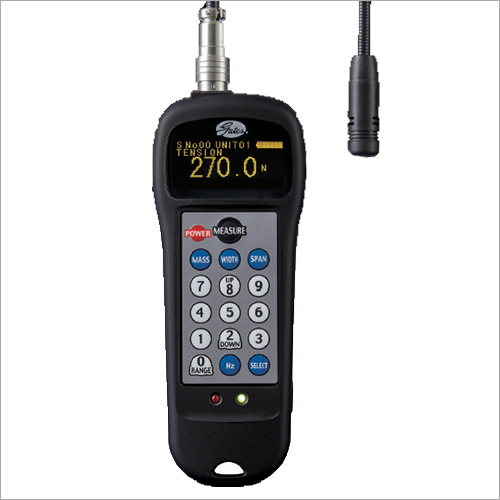
Tell us about your requirement

Price:
Quantity
Select Unit
- 50
- 100
- 200
- 250
- 500
- 1000+
Additional detail
Mobile number
Email

More Products in U508 Belt Tension Gauge Meter Category
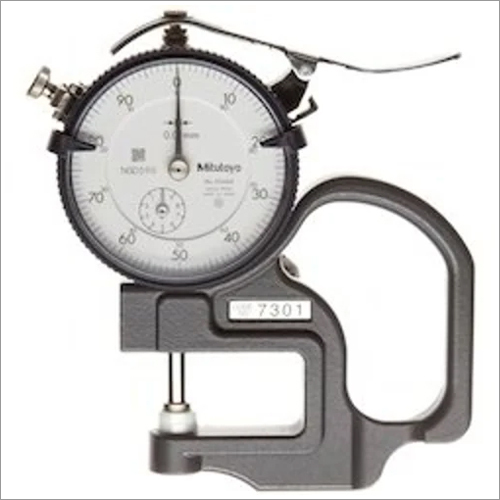
Digital Dial Thickness Gauge
Minimum Order Quantity : 1 Unit
Sensor Type : Electronic digital sensor
Measuring Range : 010 mm
Application : Other, Precise thickness measurement of paper, film, sheet, wire, etc.
Grade : Industrial grade
Seal Material : Metal/Plastic combination

BHAGWATI HARDWARE & MILL STORE
GST : 07AAVPG1611J1ZO
GST : 07AAVPG1611J1ZO
B No. 4769, 1ST FLOOR, HAUZ QAZI, Delhi - 110006, India
Phone :08045478407

 Send Inquiry
- Measuring Testing Instruments
- Gauges And Test Stands
- Hardness Testers
- Elekrophysik Coating Thickness Gauges DFT Meter
- Internal And External Calipers
- NDT Instruments
- Tension Meters
- Torque Wrench And Torque Testers
- U508 Belt Tension Gauge Meter
- Illuminated Magnifier
- Grinding And Milling Vices Goldsmith Make
- Spotron Weld Force Gauge
- Magnifying Glass
- Citizen Measuring Instruments
- Load Cells And Amplifier For Special Application
- Vibration And Sound Level Meter
- TM-801 Gauss Meter Tesla Meter
- Dial Thickness Gauges
- Showa Sokki
- Surface Roughness Tester And Surface Finish Tester
- Automatic Digital Rockwell Hardness Tester
- Data Logging Systems
- Digital Gloss Meter
- Moisture Meters
- JFE Advance Tech
- Caliper Gauge
- Digital Gauge
- Grinding Vice
- Measuring Tools
- Handy Durometer
- Torque Tester
 Send Inquiry
 Send SMS
BHAGWATI HARDWARE & MILL STORE
All Rights Reserved.(Terms of Use)
Developed and Managed by Infocom Network Private Limited.
Developed and Managed by Infocom Network Private Limited.

